Solvent Recycling - Industrial Washing - Sales - Service

Solvent Recycling Principles
There are three general types of solvent recovery unit.
Simple dry distillation, fractional distillation and thin film evaporation.
The simple dry distillation units are the types serviced and supplied by Green Equipment.
During the distillation process, solvents contaminated with pigments, resins, polymers, paints, oils, etc, are heated in a chamber (Distillation column) by electric heaters, steam or thermal oil.
When the solvent has reached boiling point (this varies with different solvents), vapour is produced (Evaporator) which is then condensed through a water coil (Condenser).
The vapour is then reverted back into liquid as it passes through the condenser and collected in a storage container.
The waste residues remaining in the distillation column is then drained and disposed of in a safe manner.
These distillation units can be run in single operation batches or continuous operation with automatic feeding of contaminated solvent and draining of waste residue.
They can also be run with vacuum assistance to lower the boiling point of solvent.
Vacuum would be used for high boiling point solvents and wastes containing heat sensitive chemicals such as nitrocellulose, sometimes used in printing inks.
Industrial Washing Machines
Washing and cleaning systems can use either solvents or aqueous based solutions depending on what is being cleaned. In either case, dirty solvents or water can be recycled and used again when used in-line with a recovery unit.
There are different principles involved such as immersion, high pressure spray with and without brushing, vapour degreasing etc..
Various cycles of wash are available to suit components being washed. This can include pre-rinse, main wash, final rinse and drying followed by recovery of washing medium.
They can vary in size and have different loading capabilities such as top loading, side loading and end loading.
Handling of the items being loaded into units can be manual or automatic depending on volume, size and weight.
The main advantages of machine washing over manual washing would be reduced operator contact with chemicals, reduced respiratory exposure to solvents, no open containers of flammable liquids, using less cleaning mediums due to recycling, lower labour costs, consistantly cleaner parts and reduced downtime of production equipment.
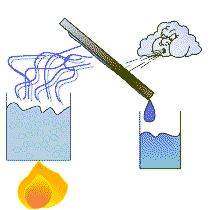
'Distillation is defined as a process in which a liquid mixture of two or more substances is separated into it's component fractions of desired purity, by the application and removal of heat.'
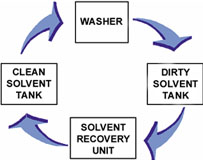
When using washing machines with in-line recovery units, dirty solvent and waste water can be recycled to be used again.
Green Equipment Ltd
For further enquiries, call Green Equipment on +44(0)1244 374205 or +44(0)7939056170
info@green-equipment.co.uk
© Copyright Green Equipment Ltd 2009
Registered in England No: 4759703